If journaling feels like something you want to do but you’re not sure where to actually begin, I am here to help you. I get asked about journaling a lot, and I think it’s because people know I love to journal and they want to see if there’s a code to be cracked when it comes to journaling consistency.
There isn’t, really.
I’ve just been doing it long enough that it stopped feeling like a thing I had to do and started feeling like something I wanted to do. Over the years, it’s become a part of how I take care of myself. I also like having a record of my own life. And, I take it seriously by not taking it too seriously.
If you want to start and don’t know where to begin or you want to make it a part of your routine, here’s what’s actually worked for me, a little Journaling 101, if you’d like:
If you don’t know where to start
The beginning of a journal is genuinely the hardest part. Buying the journal itself can feel like a decision you have to make perfectly. (If you’re wondering, I prefer a hardcover journal because it’s sturdier, and lined pages because I occasionally write crooked.)
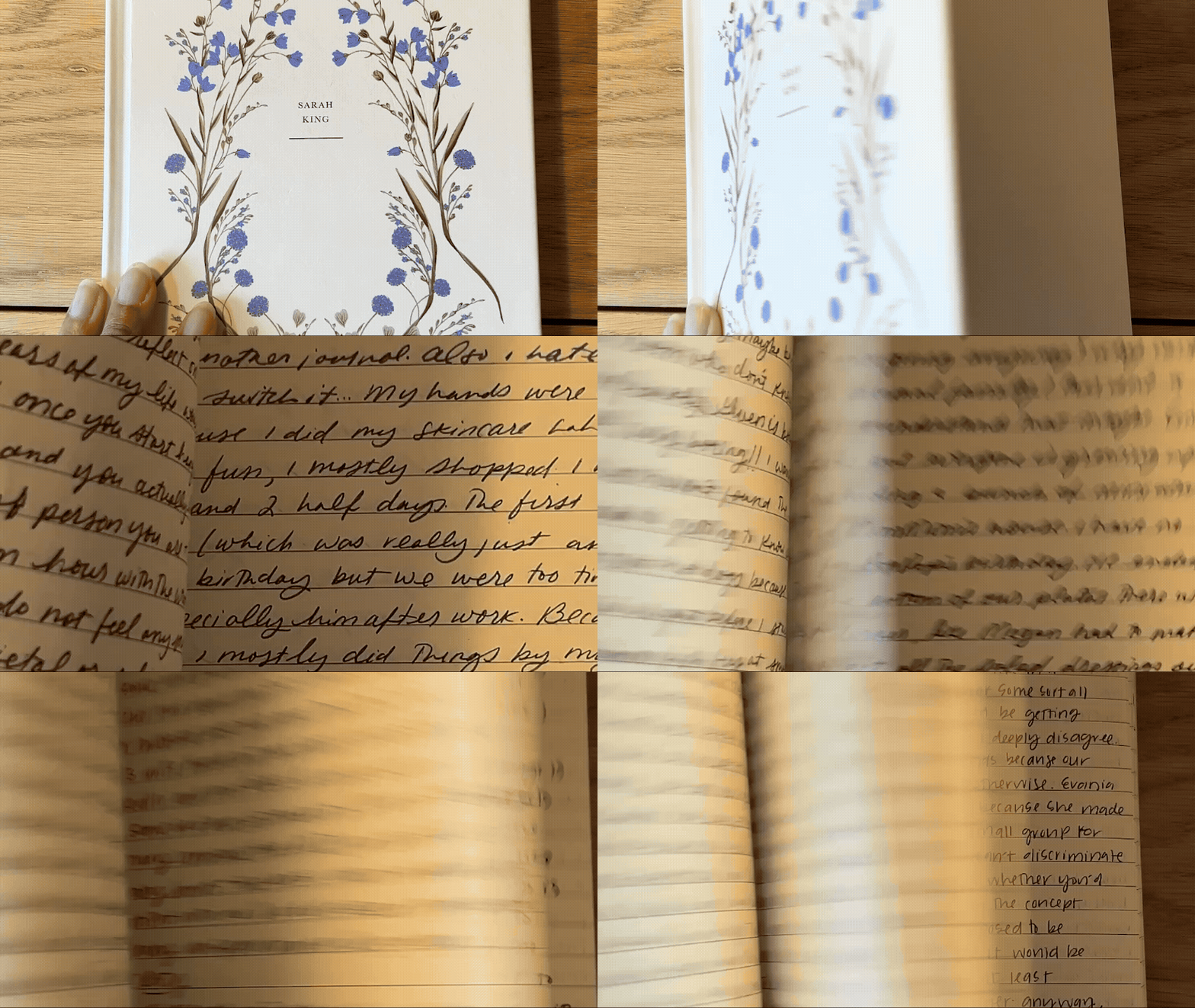
My best advice here is to just treat it like a diary. You can literally write “dear diary” in the most elementary-school way imaginable. Or pretend you’re talking to the journal itself, or updating a close friend on your life. It creates a little distance between you and your brain, which helps when it’s easy to overthink or be self-conscious.
One of my favorite books is Dracula, and the whole thing is written through diaries, journals, and letters. One character doesn’t even write at all, he just records himself so that’s actually an option!! If your brain moves faster than your hand, voice memos or video recordings work too. The format doesn’t matter at the end of the day, the archive does.
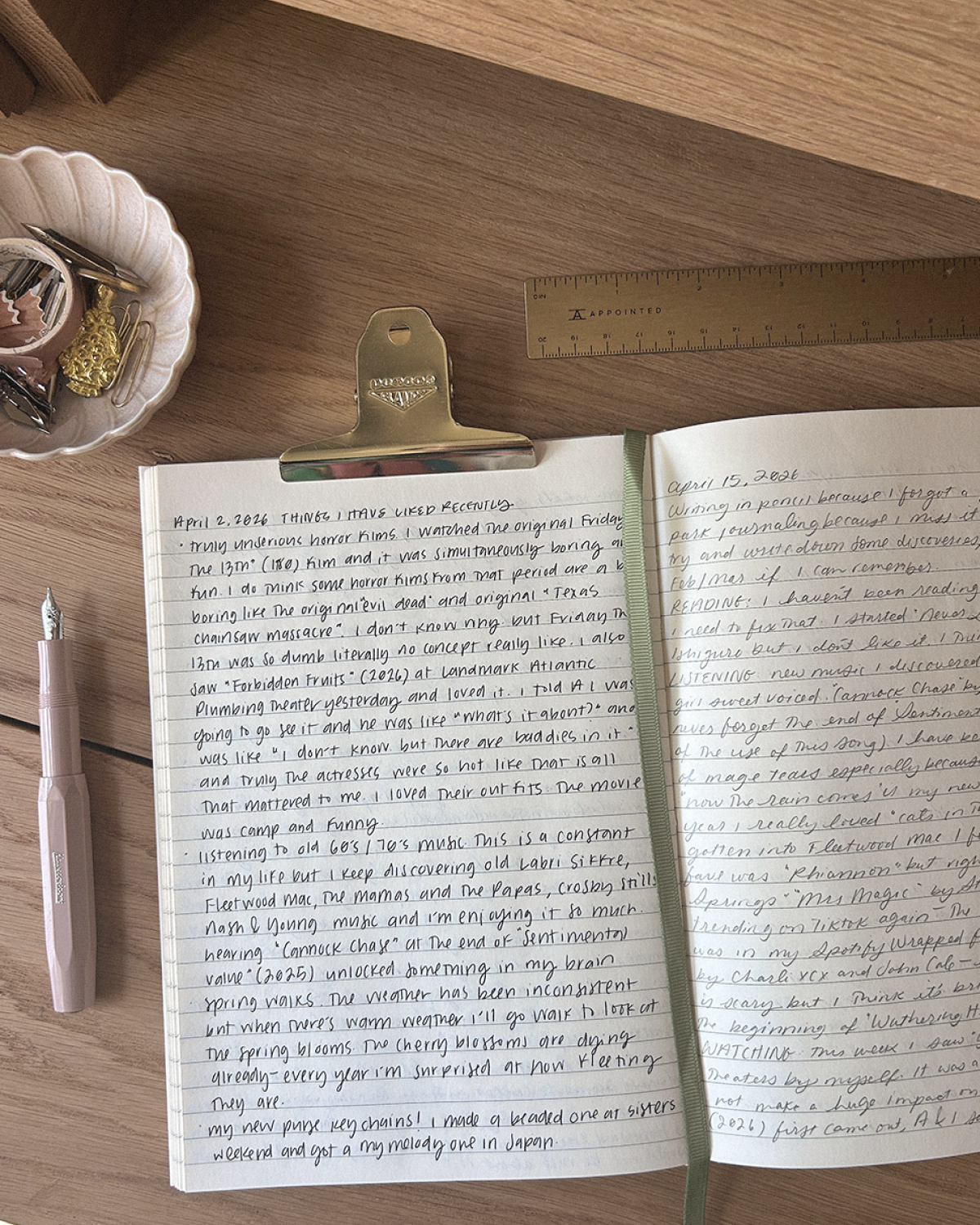
If you want something even simpler to start: take one page and split it in half. In bullet points, write
- “things I’ve liked recently” on one half and
- “things I’ve disliked recently” on the other.
That’s it! I do this at least once a week, and even though it’s so simple, it works because it holds both things at once: what’s been hard and what’s been good, without making either one a bigger deal than it is.
There are positive things and there are annoyances, and I believe in approaching them both the same way (so it doesn’t feel like a big emotional exercise).
If journaling is making you feel worse
My last journal, which I wrote sporadically from 2020 to 2025, was genuinely the journal of suffering and despair. It is so painful to read it. It was just me cycling through the same worries, insecurities, rejections, and fears, over and over again. So I’ll be the first to say: journaling is not a cure. You won’t feel better every time. Sometimes after writing something down the feeling still lingers.
What I try to do after a rough entry is end with one sentence of positivity. It’s really cheesy, and not in my nature at all as a pessimist (hence, my previous journal being the journal of suffering and despair) which is exactly why I say it’s one sentence and not a whole gratitude list. It’s also not a “Well, everything’s fine anyway” which will negate your feelings entirely.
Just one sentence to lighten the mood a little bit can reframe your perspective in the tiniest way. It just has to shift something in your brain slightly. And to me, that’s what journaling is all about: noticing patterns, catching negative thoughts, finding a slightly different angle on something, and growing.
Another thing that’s helped: writing about what you actually like about yourself. Not in a forced way, but really think about it. Do you love that you have good taste in music? Write about it. Are you getting closer to people in your life? Write about what that feels like.
If you can’t make it a habit
I don’t write every day. I used to feel bad about that, but I don’t anymore, because the pressure to write daily was doing more harm than the journaling was doing good. Some people swear by morning pages and writing every single day. That’s so great for them. It doesn’t work for me personally, and it might not work for you.
If you want some structure to start with, here’s what I’d suggest:
- Daily: one thing you did, are doing, or are looking forward to
- Weekly: a few bullet points of things that happened (or the likes/dislikes I mentioned above)
- Monthly: a short entry of what you did, liked, disliked, and enjoyed that month
Because life moves fast and it can be hard to remember what you did, I also keep other systems: my Google calendar, my Notes app, Letterboxd, Spotify stats. They fill in the gaps when I need to remember what I was actually doing.
If journaling feels too simple
There’s a lot of journaling advice that sounds like “write what you’re grateful for,” and while that is good advice, it can start to feel shallow or hollow after a while. “I am grateful for clean water.” can feel almost too small to bother with (even though I am grateful for my clean water. Who isn’t??).
But honestly, I am grateful for clean water and drinking it from my little Hydroflask. That is legitimately a pillar of my life. If I don’t have cold, crisp water in my little cup, I won’t drink any water at all, and my day-to-day will feel off-balanced from not taking care of my health. It sounds dramatic, but noticing these patterns do matter and being grateful for the small things is not beneath the practice.
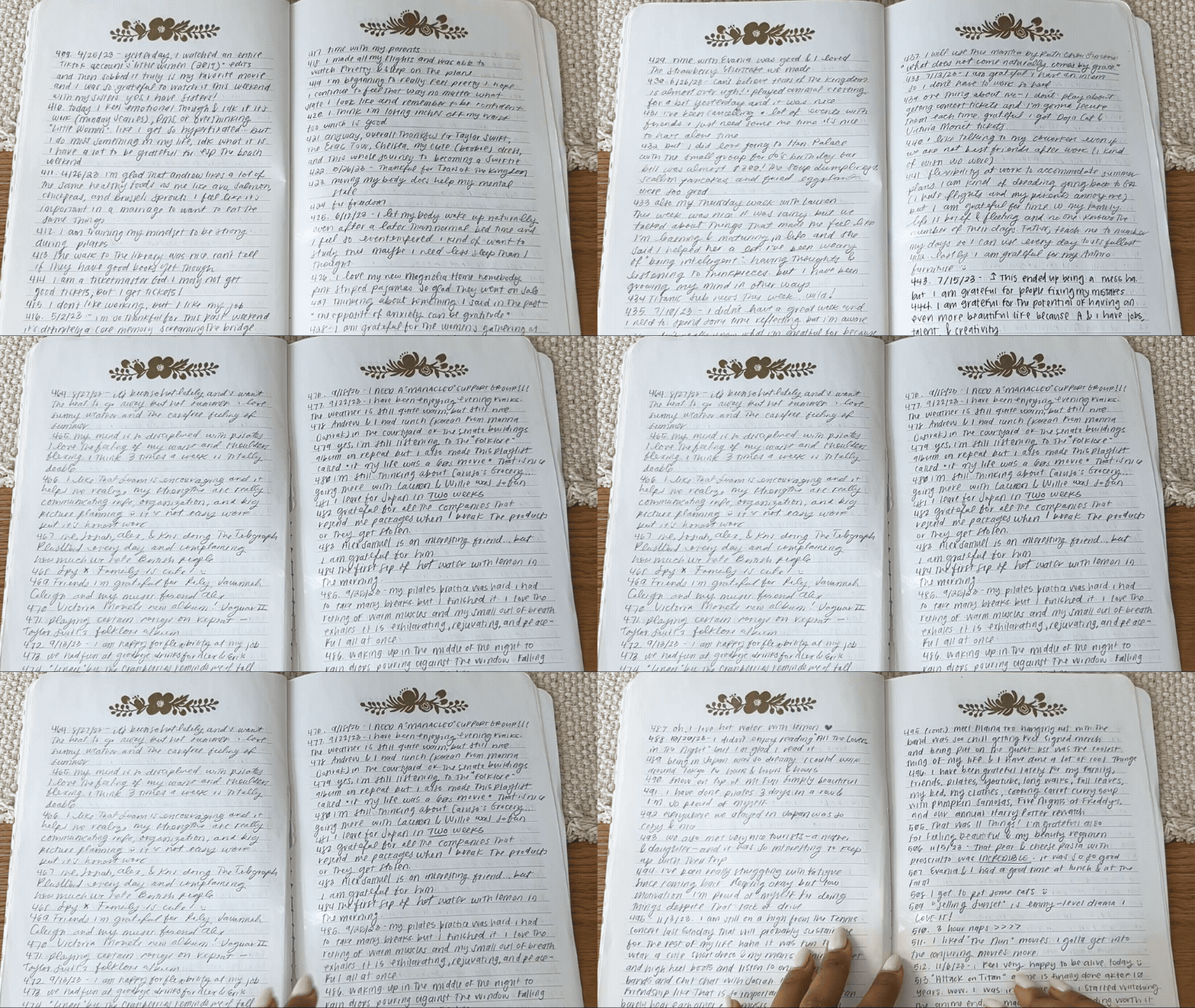
And what is wrong with simplicity? The small things are what make up a life. Life isn’t made up of huge, extraordinary moments. It’s made up of tiny habits, little moments that point to something larger and become the foundation of an actual, lived life.
Here’s your reminder that your journal doesn’t need to be aesthetic or perfect or profound or be content-ified. (I say that as someone who makes content about her journals.) No one is going to publish and read your journals (unless they will, then congrats we have Joan Didion over here!!).
Your journal is just for you. And I think once you start to realize that, the simplicity stops feeling like a limitation and starts feeling like a strength.




Be the first to comment.
Add to the conversation